Mini Bike GPS Dyno
A Raspberry Pi and a GPS clipped to a mini bike work out its horsepower from how fast it speeds up, and a phone app shows every run as a chart.
Board: Raspberry Pi 3 B+ (any Pi with Wi-Fi works)
Work in progress. The software is finished and passes its tests (a simulated 6.5 hp engine measured 6.55 hp), and the phone app works. The GPS isn't wired to the Pi yet, so there are no real rides yet.
What you need
What it is
A real dyno (the machine that measures an engine's horsepower) costs a lot. This one is a Raspberry Pi and a GPS in a pouch on the bike. Ride up and down the driveway, and the Pi records each run by itself. Afterwards, the phone app shows speed and horsepower charts for every run, and lets you compare runs (like before and after a new carburetor).
How it works
- The GPS reports the bike's speed 10 times a second. It's set up in its own language (UBX) for the fastest, smoothest readings.
- Runs record themselves: going faster than 3 mph starts a run (keeping the 2 seconds before it), and slower than 2 mph for 1.5 seconds ends it. Runs that never reach 5 mph are ignored.
- The horsepower maths: pushing the bike forward takes force:
force = weight x acceleration + rolling resistance + air drag + hill
power = force x speed
That's the power at the wheel. Dividing by how much the drivetrain wastes (a clutch keeps about 85%, a torque converter about 70%) estimates the engine's horsepower.
- Best results: do one run each way along the driveway and compare them. The slope and wind push one way on one run and the other way on the next, so they cancel out.
- Sensors are plug-ins. The app's Sensors page lists every type (GPS, a practice GPS for testing, RPM pickups, accelerometer), so adding one later is just filling in a form.
Build it
1Set up the Pi
Install Raspberry Pi OS. Then in a terminal run sudo raspi-config and under Interface Options:
- Serial Port: login shell over serial No, serial port hardware Yes.
- I2C: Yes (for the accelerometer later).
Reboot afterwards.
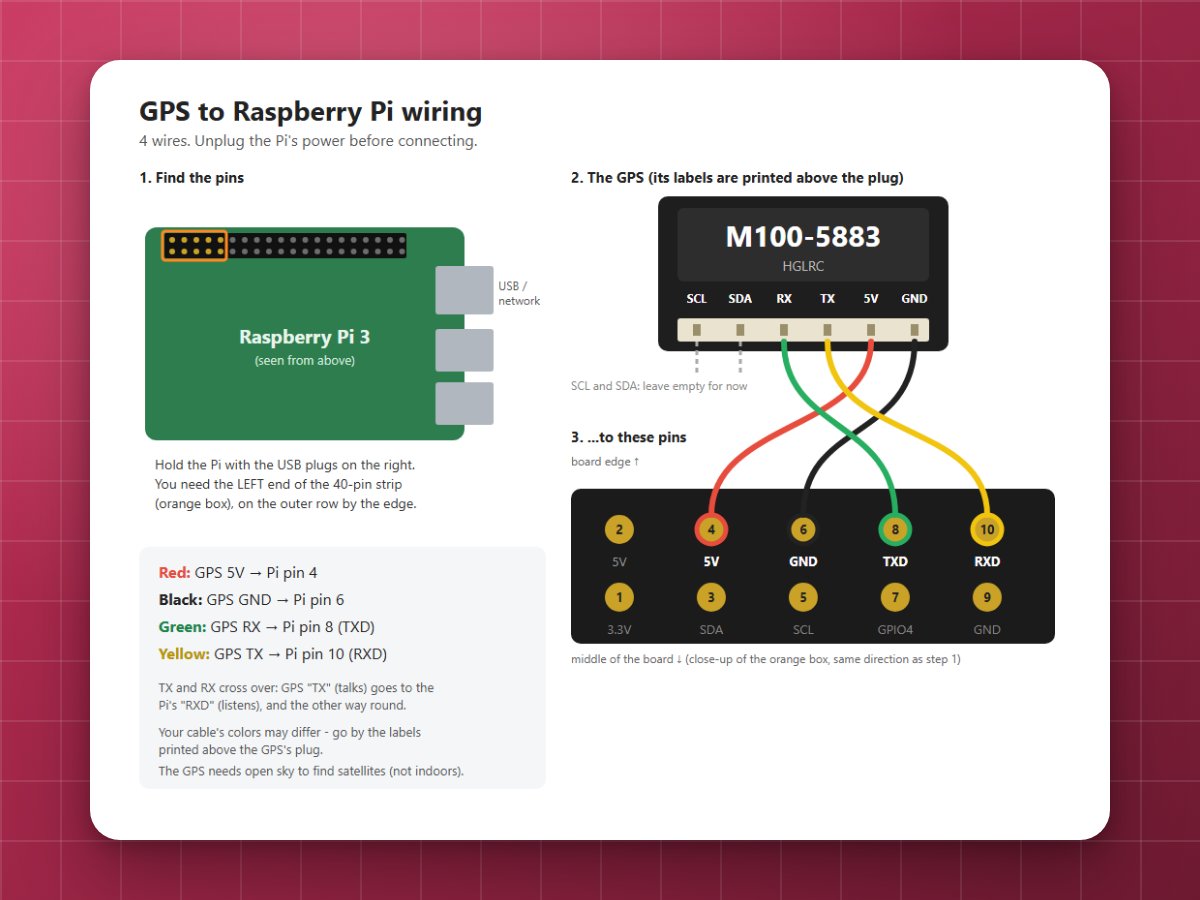
2Wire the GPS
Four wires to the Pi's 40-pin header:
| GPS | Pi pin |
|---|---|
| 5V | pin 4 (5V) |
| GND | pin 6 (GND) |
| RX | pin 8 (TXD) |
| TX | pin 10 (RXD) |
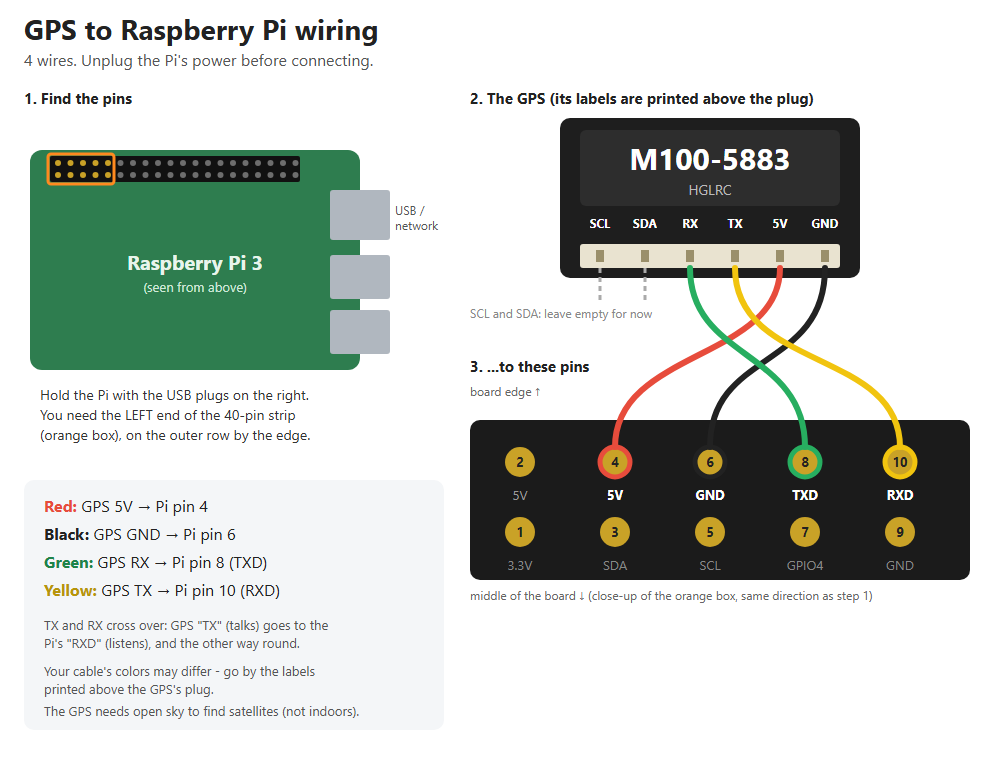
Tip: The GPS's RX goes to the Pi's TX and the other way round: each one's "talk" wire goes to the other's "listen" pin.
3Install the program
Copy the minibike-dyno folder from the zip to the Pi's home folder, then:
sudo loginctl enable-linger $USER
cd ~/minibike-dyno
bash install.sh
That makes it start by itself every time the Pi powers on, even with no screen or keyboard. Your settings and runs are saved in ~/minibike-dyno-data.
4Open the app
On your phone, open http://<the Pi's address>:8080 in the browser (your router's device list shows the Pi's address, or try http://raspberrypi.local:8080). Add it to your home screen so it opens like an app.
5Enter your weights
In Settings, enter the bike's weight and your weight, and pick clutch or torque converter. Horsepower depends on weight, so the app reminds you until you've set them.
6Ride
Wait for the GPS to find satellites (outside, a minute or two the first time), then do a few runs each way. Watch them appear in Runs.
Adding sensors later
- Wheel RPM: a hall-effect sensor (powered from 3.3 V, pin 1, never 5 V into a Pi pin) on GPIO17 (pin 11), with a magnet on the wheel. Wheel speed is smoother than GPS.
- Engine RPM: the same kind of pickup, set to "engine". Unlocks power and torque by RPM.
- Accelerometer: a GY-521 module on I2C (3.3 V pin 1, GND pin 9, SDA pin 3, SCL pin 5).
Run the self-tests
On the Pi, in the minibike-dyno folder: python3 -m unittest discover -s tests. One of the tests is a pretend ride with a simulated 6.5 hp engine.
The code
A Python program for the Pi (no extra packages: it only uses what comes with Raspberry Pi OS) and the app's web page. Download the .zip, copy the minibike-dyno folder to the Pi, and run install.sh.
Download all the code (.zip)"""Starts everything: sensors -> recorder -> web server on port 8080."""import signalimport sysimport threadingfrom . import config, serverfrom .recorder import Recorderfrom .sensors import SensorManagerdef main(): port = int(sys.argv[1]) if len(sys.argv) > 1 else 8080 recorder = Recorder() manager = SensorManager(recorder.emit) manager.start(config.load_sensors()) dyno = server.Dyno(recorder, manager) httpd = server.serve(dyno, port) stop = threading.Event() def shut_down(*_): if not stop.is_set(): stop.set() threading.Thread(target=httpd.shutdown, daemon=True).start() signal.signal(signal.SIGTERM, shut_down) signal.signal(signal.SIGINT, shut_down) print("Mini bike dyno running on port %d, data in %s" % (port, config.DATA_DIR), flush=True) httpd.serve_forever() manager.start([]) # stop the sensors if recorder.run is not None: recorder.manual_stop() # save a run that was in progressif __name__ == "__main__": main()Every kind of sensor. To add a new one, write one class marked @sensor_type.
"""Sensors. Each type describes its own options, so the app can add and set them upwithout code changes. Every sensor runs in its own thread and sends readings toemit(channel, monotonic_time, value): channel "gps" value = dict from ubx.parse_nav_pvt (speed_mps, fix_ok, sats, ...) channel "wheel_rpm" value = rear wheel revolutions per minute channel "engine_rpm" value = engine revolutions per minute channel "accel_g" value = forward acceleration in g (from an accelerometer)"""import mathimport randomimport threadingimport timefrom . import ubxSENSOR_TYPES = {}def sensor_type(name, label, options, channels, help_text=""): def register(cls): SENSOR_TYPES[name] = {"label": label, "class": cls, "options": options, "channels": channels, "help": help_text} cls.type_name = name return cls return registerdef describe_types(): """What the app's "Add sensor" form needs, without the Python classes.""" return {name: {k: v for k, v in info.items() if k != "class"} for name, info in SENSOR_TYPES.items()}class Sensor: def __init__(self, config, emit): self.config = config self.emit = emit self.stop_event = threading.Event() self.thread = None self.state = "starting" self.detail = "" self.last_reading = 0.0 def opt(self, key): for option in SENSOR_TYPES[self.type_name]["options"]: if option["key"] == key: return self.config.get(key, option["default"]) return self.config.get(key) def start(self): self.thread = threading.Thread(target=self._run_forever, daemon=True, name="sensor-" + self.config.get("id", "?")) self.thread.start() def stop(self): self.stop_event.set() if self.thread: self.thread.join(timeout=3) def _run_forever(self): while not self.stop_event.is_set(): try: self.run() except Exception as e: # keep going: a loose wire shouldn't kill the dyno self.state = "error" self.detail = str(e)[:200] self.stop_event.wait(2) def run(self): raise NotImplementedError def status(self): age = time.monotonic() - self.last_reading if self.last_reading else None return {"id": self.config.get("id"), "type": self.type_name, "name": self.config.get("name"), "state": self.state, "detail": self.detail, "seconds_since_reading": round(age, 1) if age is not None else None}# ---------------------------------------------------------------- GPS ---@sensor_type( "ublox_gps", "GPS (u-blox, like the HGLRC M100)", options=[ {"key": "port", "label": "Serial port", "kind": "text", "default": "/dev/serial0", "help": "/dev/serial0 = the Pi's pins 8 (TX) and 10 (RX)"}, {"key": "rate_hz", "label": "Updates per second", "kind": "select", "default": 10, "choices": [5, 10, 15]}, ], channels=["gps"], help_text="Wire GPS TX to Pi pin 10, GPS RX to pin 8, 5V to pin 4, GND to pin 6.")class UbloxGps(Sensor): BAUDS = [115200, 9600, 38400, 57600, 230400] def run(self): import serial # pyserial, part of Raspberry Pi OS port = self.opt("port") self.state = "searching" self.detail = "looking for the GPS on " + port baud = self._find_baud(serial, port) if baud is None: self.state = "no data" self.detail = "nothing heard on %s (check the wires, TX goes to pin 10)" % port return if baud != 115200: with serial.Serial(port, baud, timeout=0.2) as ser: ser.write(ubx.valset({"CFG-UART1-BAUDRATE": 115200})) ser.flush() time.sleep(0.3) with serial.Serial(port, 115200, timeout=0.2) as ser: self._configure(ser) self._read_loop(ser) def _find_baud(self, serial, port): for baud in self.BAUDS: if self.stop_event.is_set(): return None try: with serial.Serial(port, baud, timeout=0.2) as ser: ser.reset_input_buffer() data = b"" end = time.monotonic() + 1.3 while time.monotonic() < end: data += ser.read(512) if ubx.SYNC in data or b"$G" in data: return baud except OSError as e: self.detail = "can't open %s: %s" % (port, e) time.sleep(1) return None def _configure(self, ser): rate_ms = int(round(1000 / int(self.opt("rate_hz")))) full = { "CFG-RATE-MEAS": rate_ms, "CFG-RATE-NAV": 1, "CFG-UART1OUTPROT-UBX": 1, "CFG-UART1OUTPROT-NMEA": 0, "CFG-MSGOUT-UBX_NAV_PVT_UART1": 1, "CFG-NAVSPG-DYNMODEL": 4, # GPS + Galileo only, so the M10 can keep up 10 fixes a second "CFG-SIGNAL-GLO_ENA": 0, "CFG-SIGNAL-BDS_ENA": 0, } basic = {k: v for k, v in full.items() if "SIGNAL" not in k} for values in (full, basic): ser.reset_input_buffer() ser.write(ubx.valset(values)) ser.flush() if self._wait_ack(ser): self.detail = "configured: %d Hz, UBX" % int(self.opt("rate_hz")) return True self.detail = "GPS didn't confirm the settings (it may still work at its own rate)" return False def _wait_ack(self, ser): reader = ubx.Reader() end = time.monotonic() + 1.5 while time.monotonic() < end: for cls, mid, payload in reader.feed(ser.read(256)): if cls == 0x05 and len(payload) >= 2 and payload[0] == 0x06 and payload[1] == 0x8A: return mid == 0x01 # 0x01 = ACK, 0x00 = NAK return False def _read_loop(self, ser): reader = ubx.Reader() last_msg = time.monotonic() count_start, count = time.monotonic(), 0 self.state = "waiting for fix" while not self.stop_event.is_set(): data = ser.read(512) now = time.monotonic() for cls, mid, payload in reader.feed(data): if cls == 0x01 and mid == 0x07: pvt = ubx.parse_nav_pvt(payload) if not pvt: continue last_msg = now count += 1 self.last_reading = now self.emit("gps", now, pvt) if pvt["fix_ok"]: self.state = "ok" self.detail = "%s fix, %d satellites" % (ubx.FIX_NAMES.get(pvt["fix"], "?"), pvt["sats"]) else: self.state = "waiting for fix" self.detail = "%d satellites so far (needs open sky)" % pvt["sats"] if now - count_start >= 5: self.rate = count / (now - count_start) count_start, count = now, 0 if now - last_msg > 4: self.state = "no data" self.detail = "GPS went quiet, reconnecting" return # _run_forever reconnects and reconfigures def status(self): s = super().status() s["rate_hz"] = round(getattr(self, "rate", 0.0), 1) return s# ----------------------------------------------------- practice / demo ---@sensor_type( "sim_gps", "Practice GPS (fake rides, for trying the app)", options=[ {"key": "engine_hp", "label": "Pretend engine horsepower", "kind": "number", "default": 6.5}, {"key": "every_s", "label": "Seconds between fake rides", "kind": "number", "default": 40}, ], channels=["gps"], help_text="Makes up a ride every so often so you can see how runs look. " "Turn it off before real riding.")class SimulatedGps(Sensor): def run(self): from .analysis import simulate_run self.state = "ok" while not self.stop_event.is_set(): self.detail = "parked" self._stream(None, 3.0) ride = simulate_run(engine_hp=float(self.opt("engine_hp")), seconds=9.0) self.detail = "doing a fake ride" self._stream(ride, None) self.detail = "parked" self._stream(None, max(5.0, float(self.opt("every_s")))) def _stream(self, ride, seconds): """Send 10 Hz fixes: the ride's speeds, or standing still for `seconds`.""" speeds = ride["speed_mps"] if ride else [0.0] * int(seconds * 10) for v in speeds: if self.stop_event.is_set(): return now = time.monotonic() self.last_reading = now noisy = max(0.0, v + random.gauss(0, 0.04)) self.emit("gps", now, {"fix": 3, "fix_ok": True, "sats": 14, "speed_mps": noisy, "speed_acc_mps": 0.15, "lat": 0.0, "lon": 0.0, "alt_m": 0.0, "heading_deg": 90.0, "itow_ms": int(now * 1000), "utc": time.strftime("%Y-%m-%dT%H:%M:%SZ", time.gmtime())}) time.sleep(0.1)# --------------------------------------------------- RPM (wheel/engine) ---@sensor_type( "pulse_rpm", "RPM pickup (hall sensor, magnet, or tach signal)", options=[ {"key": "role", "label": "Measures", "kind": "select", "default": "wheel", "choices": ["wheel", "engine"]}, {"key": "gpio", "label": "GPIO number (not pin number)", "kind": "number", "default": 17, "help": "GPIO17 is physical pin 11. Power 3.3V sensors from pin 1, never 5V into a GPIO."}, {"key": "pulses_per_rev", "label": "Pulses per revolution", "kind": "number", "default": 1, "help": "Number of magnets on the wheel, or tach pulses per engine turn"}, {"key": "pull", "label": "Pull resistor", "kind": "select", "default": "up", "choices": ["up", "down", "none"]}, {"key": "edge", "label": "Count on", "kind": "select", "default": "falling", "choices": ["falling", "rising"]}, {"key": "max_rpm", "label": "Highest believable RPM", "kind": "number", "default": 6000, "help": "Pulses faster than this are treated as electrical noise"}, ], channels=["wheel_rpm", "engine_rpm"], help_text="One magnet on the wheel + a hall sensor (3.3V) is enough for wheel speed.")class PulseRpm(Sensor): def run(self): import lgpio # part of Raspberry Pi OS gpio = int(self.opt("gpio")) ppr = max(1, int(self.opt("pulses_per_rev"))) channel = "engine_rpm" if self.opt("role") == "engine" else "wheel_rpm" max_rpm = max(100.0, float(self.opt("max_rpm"))) min_gap_ns = int(60e9 / (max_rpm * ppr)) flags = {"up": lgpio.SET_PULL_UP, "down": lgpio.SET_PULL_DOWN}.get(self.opt("pull"), 0) edge = lgpio.FALLING_EDGE if self.opt("edge") == "falling" else lgpio.RISING_EDGE lock = threading.Lock() pulses = [] # the GPIO library's timestamp (ns) of recent pulses, for exact spacing last_arrival = [0] # our own clock when the latest pulse arrived, for "how long ago" handle = lgpio.gpiochip_open(0) try: lgpio.gpio_claim_alert(handle, gpio, edge, flags) def on_pulse(chip, g, level, tick): with lock: if pulses and tick - pulses[-1] < min_gap_ns: return # too soon: a bounce or electrical noise pulses.append(tick) del pulses[:-64] last_arrival[0] = time.monotonic_ns() callback = lgpio.callback(handle, gpio, edge, on_pulse) self.state = "ok" self.detail = "GPIO%d, %d pulse(s)/rev" % (gpio, ppr) while not self.stop_event.wait(0.05): # 20 readings a second with lock: recent = list(pulses[-(ppr + 1):]) since_last = time.monotonic_ns() - last_arrival[0] rpm = 0.0 if len(recent) >= 2: # average spacing over the last full turn (or as much as we have) period_ns = (recent[-1] - recent[0]) / (len(recent) - 1) * ppr if period_ns > 0 and since_last < max(2 * period_ns, 1e8): rpm = 60e9 / period_ns elif since_last < 3e9: rpm = 60e9 / (since_last * ppr) # slowing down, no new pulse yet self.last_reading = time.monotonic() self.emit(channel, self.last_reading, rpm) callback.cancel() finally: lgpio.gpiochip_close(handle)# ------------------------------------------------------- accelerometer ---@sensor_type( "mpu6050", "Accelerometer (GY-521 / MPU-6050, from your 37-sensor kit)", options=[ {"key": "bus", "label": "I2C bus", "kind": "number", "default": 1}, {"key": "address", "label": "Address", "kind": "select", "default": "0x68", "choices": ["0x68", "0x69"]}, {"key": "forward", "label": "Axis pointing forward", "kind": "select", "default": "x", "choices": ["x", "-x", "y", "-y"]}, {"key": "rate_hz", "label": "Readings per second", "kind": "number", "default": 50}, ], channels=["accel_g"], help_text="VCC to pin 1 (3.3V), GND to pin 9, SDA to pin 3, SCL to pin 5. " "Mount it flat; it zeroes itself while the bike stands still at power-on.")class Mpu6050(Sensor): def run(self): from smbus2 import SMBus address = int(str(self.opt("address")), 16) axis = self.opt("forward") index = 0 if "x" in axis else 1 sign = -1.0 if axis.startswith("-") else 1.0 period = 1.0 / max(5.0, min(200.0, float(self.opt("rate_hz")))) with SMBus(int(self.opt("bus"))) as bus: bus.write_byte_data(address, 0x6B, 0x00) # wake up bus.write_byte_data(address, 0x1A, 0x03) # 44 Hz low-pass filter bus.write_byte_data(address, 0x1C, 0x08) # +-4 g range time.sleep(0.1) def read_g(): raw = bus.read_i2c_block_data(address, 0x3B, 6) value = (raw[index * 2] << 8) | raw[index * 2 + 1] if value >= 0x8000: value -= 0x10000 return sign * value / 8192.0 # 8192 counts per g at +-4 g self.state = "zeroing" self.detail = "keep the bike still" zero = sum(read_g() for _ in range(100)) / 100.0 self.state = "ok" self.detail = "zeroed at %+.3f g" % zero while not self.stop_event.wait(period): self.last_reading = time.monotonic() self.emit("accel_g", self.last_reading, read_g() - zero)class SensorManager: """Starts the sensors listed in sensors.json and restarts them when the list changes.""" def __init__(self, emit): self.emit = emit self.sensors = [] self.lock = threading.Lock() def start(self, configs): with self.lock: for sensor in self.sensors: sensor.stop() self.sensors = [] for config in configs: info = SENSOR_TYPES.get(config.get("type")) if not info or not config.get("enabled", True): continue sensor = info["class"](config, self.emit) sensor.start() self.sensors.append(sensor) def status(self): with self.lock: return [s.status() for s in self.sensors]The horsepower maths.
"""Turns a recorded run into horsepower, acceleration and timing numbers.Physics: the force pushing the bike forward at the rear tire is F = m_eff * a + m * g * (Crr + slope) + 1/2 * rho * CdA * v^2(speeding up, + tire rolling resistance, + hill, + air drag). Power = F * v.Divide by 745.7 for horsepower at the wheel. Engine horsepower is the wheel figuredivided by the drivetrain efficiency (clutch/chain or torque converter).Speed comes from the GPS (Doppler, ~10 per second) or from a wheel RPM sensor ifone is fitted. Acceleration comes from an accelerometer if one is fitted,otherwise from how fast the smoothed speed changes."""import mathimport numpy as npG = 9.81RHO_AIR = 1.20 # kg/m^3, near sea level at room temperatureLB_TO_KG = 0.45359237MPS_TO_MPH = 2.236936W_PER_HP = 745.7M_TO_FT = 3.28084# ------------------------------------------------------------ helpers ---def savgol(values, window, deriv=0, dt=1.0): """Savitzky-Golay filter (quadratic): smooths, or gives a smooth derivative.""" values = np.asarray(values, dtype=float) n = len(values) window = int(window) | 1 if n < 3: return np.zeros(n) if deriv else values.copy() if window > n: window = n if n % 2 else n - 1 if window < 3: return np.gradient(values, dt) if deriv else values.copy() half = window // 2 x = np.arange(-half, half + 1, dtype=float) basis = np.vander(x, 3, increasing=True) # 1, x, x^2 coeffs = np.linalg.pinv(basis)[deriv] # row 0 = value, row 1 = slope padded = np.concatenate([np.full(half, values[0]), values, np.full(half, values[-1])]) out = np.convolve(padded, coeffs[::-1], mode="valid") return out / dt if deriv else outdef resample(times, values, grid): times = np.asarray(times, dtype=float) values = np.asarray(values, dtype=float) if len(times) < 2: return np.full(len(grid), values[0] if len(values) else 0.0) order = np.argsort(times) return np.interp(grid, times[order], values[order])def crossing_time(t, v, level): """First time v reaches `level`, interpolated between samples, or None.""" above = np.nonzero(v >= level)[0] if not len(above): return None i = above[0] if i == 0: return float(t[0]) v0, v1 = v[i - 1], v[i] frac = (level - v0) / (v1 - v0) if v1 != v0 else 0.0 return float(t[i - 1] + frac * (t[i] - t[i - 1]))def efficiency(settings): if settings.get("drivetrain") == "torque_converter": return float(settings["efficiency_torque_converter"]) return float(settings["efficiency_clutch"])def r(x, digits=2): return None if x is None or not math.isfinite(x) else round(float(x), digits)# ----------------------------------------------------------- analysis ---def analyze(run, settings): channels = run.get("channels", {}) warnings = [] mass = (float(settings["bike_weight_lb"]) + float(settings["rider_weight_lb"])) * LB_TO_KG mass_eff = mass * (1 + float(settings["rotating_pct"]) / 100.0) if not settings.get("weights_set"): warnings.append("Using example weights - enter your real weights in Settings.") # ---- speed (m/s) on an even time grid ---- wheel = channels.get("wheel_rpm") use_wheel = settings.get("speed_source") == "wheel" or ( settings.get("speed_source") == "auto" and wheel and max(wheel.get("v") or [0]) > 0) gps = channels.get("gps") or {} if use_wheel and wheel and len(wheel.get("t", [])) >= 5: source = "wheel sensor" t_raw = np.asarray(wheel["t"], dtype=float) circumference = math.pi * float(settings["tire_diameter_in"]) * 0.0254 v_raw = np.asarray(wheel["v"], dtype=float) / 60.0 * circumference dt = 0.05 else: source = "GPS" ok = np.asarray(gps.get("ok", []), dtype=bool) t_raw = np.asarray(gps.get("t", []), dtype=float) v_raw = np.asarray(gps.get("speed_mps", []), dtype=float) if len(ok) == len(t_raw) and len(t_raw): if ok.mean() < 0.9: warnings.append("GPS fix was weak for part of this run - park in open sky first.") t_raw, v_raw = t_raw[ok], v_raw[ok] dt = float(np.median(np.diff(t_raw))) if len(t_raw) > 2 else 0.1 dt = min(max(dt, 0.02), 0.5) if dt > 0.15: warnings.append("GPS sent only %.0f updates a second (10 is best)." % (1 / dt)) sats = gps.get("sats") or [] if sats and np.mean(sats) < 8: warnings.append("Only %.0f satellites on average - speed is less exact." % np.mean(sats)) if len(t_raw) < 8: return {"ok": False, "error": "Not enough speed readings in this run.", "warnings": warnings} grid = np.arange(t_raw.min(), t_raw.max() + 1e-9, dt) window = int(settings.get("smoothing", 7)) if source == "wheel sensor": window = window * 2 + 1 # 20 readings/s instead of 10: same smoothing in seconds v = np.clip(savgol(resample(t_raw, v_raw, grid), window), 0, None) a = savgol(resample(t_raw, v_raw, grid), window, deriv=1, dt=dt) accel_source = "speed change (" + source + ")" accel = channels.get("accel_g") if accel and len(accel.get("t", [])) >= 10: a = savgol(resample(accel["t"], accel["v"], grid), window) * G accel_source = "accelerometer" # ---- launch and the "pull" (from launch to top speed) ---- t_launch = crossing_time(grid, v, 1.0 / MPS_TO_MPH) # 1 mph if t_launch is None: return {"ok": False, "error": "The bike never got moving in this run.", "warnings": warnings} i_launch = int(np.searchsorted(grid, t_launch)) i_top = i_launch + int(np.argmax(v[i_launch:])) pull = np.arange(len(grid)) pull = (pull >= i_launch) & (pull <= i_top) & (v > 2.0 / MPS_TO_MPH) # ---- forces, power ---- slope = float(settings["slope_pct"]) / 100.0 angle = math.atan(slope) f_roll = mass * G * float(settings["crr"]) * math.cos(angle) f_hill = mass * G * math.sin(angle) f_air = 0.5 * RHO_AIR * float(settings["cda_m2"]) * v ** 2 force = mass_eff * a + f_roll + f_hill + f_air hp_wheel = force * v / W_PER_HP hp_wheel_s = savgol(hp_wheel, 5) eff = efficiency(settings) hp_engine_s = hp_wheel_s / eff t = grid - t_launch mph = v * MPS_TO_MPH distance_ft = np.concatenate([[0.0], np.cumsum((v[1:] + v[:-1]) / 2 * np.diff(grid))]) * M_TO_FT distance_ft -= np.interp(t_launch, grid, distance_ft) summary = {"speed_source": source, "accel_source": accel_source, "mass_lb": r(mass / LB_TO_KG, 0), "efficiency": eff} if pull.sum() >= 3: hp_pull = np.where(pull, hp_wheel_s, -np.inf) i_peak = int(np.argmax(hp_pull)) summary.update({ "peak_wheel_hp": r(hp_wheel_s[i_peak]), "peak_engine_hp": r(hp_engine_s[i_peak]), "peak_hp_at_mph": r(mph[i_peak], 1), "max_accel_g": r(np.max(a[pull]) / G, 2), }) else: warnings.append("The run was too short to measure power.") summary.update({ "top_mph": r(mph[i_top], 1), "time_to_top_s": r(grid[i_top] - t_launch, 2), "zero_to_10_s": r(_since(crossing_time(grid, v, 10 / MPS_TO_MPH), t_launch)), "zero_to_20_s": r(_since(crossing_time(grid, v, 20 / MPS_TO_MPH), t_launch)), "zero_to_30_s": r(_since(crossing_time(grid, v, 30 / MPS_TO_MPH), t_launch)), "sixty_ft_s": r(_since(crossing_time(grid, distance_ft, 60.0), 0.0) if distance_ft[-1] >= 60 else None), "distance_ft": r(float(np.max(distance_ft)), 0), }) # ---- engine RPM: the classic dyno chart (power and torque by RPM) ---- by_rpm = None engine = channels.get("engine_rpm") if engine and len(engine.get("t", [])) >= 10 and max(engine["v"]) > 500: rpm = savgol(resample(engine["t"], engine["v"], grid), window) ok_rpm = pull & (rpm > 1000) if ok_rpm.sum() >= 3: torque = hp_engine_s * 5252.0 / np.maximum(rpm, 1) by_rpm = {"rpm": _list(rpm[ok_rpm], 0), "hp": _list(hp_engine_s[ok_rpm]), "torque_lbft": _list(torque[ok_rpm])} i = int(np.argmax(np.where(ok_rpm, hp_engine_s, -np.inf))) summary["peak_hp_at_rpm"] = r(rpm[i], 0) summary["peak_torque_lbft"] = r(float(np.max(torque[ok_rpm]))) keep = (t >= -1.0) series = { "t": _list(t[keep]), "mph": _list(mph[keep], 1), "accel_g": _list(a[keep] / G, 3), "hp_wheel": _list(np.where(v[keep] > 1 / MPS_TO_MPH, hp_wheel_s[keep], 0)), "distance_ft": _list(distance_ft[keep], 1), } for name in ("wheel_rpm", "engine_rpm"): ch = channels.get(name) if ch and len(ch.get("t", [])) >= 2: series[name] = _list(resample(ch["t"], ch["v"], grid)[keep], 0) curve = {"mph": _list(mph[pull], 1), "hp_wheel": _list(hp_wheel_s[pull]), "hp_engine": _list(hp_engine_s[pull])} return {"ok": True, "summary": summary, "series": series, "curve_by_speed": curve, "curve_by_rpm": by_rpm, "warnings": warnings}def _since(t, t0): return None if t is None else t - t0def _list(arr, digits=2): return [round(float(x), digits) for x in arr]# --------------------------------------------------------- simulation ---def simulate_run(engine_hp=6.5, seconds=9.0, settings=None, top_mph=36.0, dt_out=0.1): """A believable mini bike pull, used by the practice GPS and the self-test. The engine makes `engine_hp` at the crank; the clutch/chain passes on the usual share; traction limits the launch; power fades near the governed top speed. Then it brakes to a stop. """ from .config import DEFAULT_SETTINGS s = dict(DEFAULT_SETTINGS) s.update(settings or {}) mass = (s["bike_weight_lb"] + s["rider_weight_lb"]) * LB_TO_KG mass_eff = mass * (1 + s["rotating_pct"] / 100.0) p_wheel = engine_hp * W_PER_HP * efficiency(s) f_traction = 0.45 * mass * G v_top = top_mph / MPS_TO_MPH angle = math.atan(s["slope_pct"] / 100.0) v, t, h = 0.0, 0.0, 0.002 out_t, out_v, next_out = [], [], 0.0 braking = False while True: if not braking and (t >= seconds or v >= v_top * 0.995): braking = True if braking: drive = -0.45 * mass * G else: power = p_wheel * max(0.0, 1 - (v / v_top) ** 8) drive = min(f_traction, power / max(v, 0.1)) resist = mass * G * (s["crr"] * math.cos(angle) + math.sin(angle)) + 0.5 * RHO_AIR * s["cda_m2"] * v * v v = max(0.0, v + (drive - resist) / mass_eff * h) t += h if t >= next_out: out_t.append(round(t, 3)) out_v.append(v) next_out += dt_out if braking and v <= 0.0: break return {"t": out_t, "speed_mps": out_v, "wheel_hp": p_wheel / W_PER_HP}Starts and stops runs by itself.
"""Keeps the latest readings for the live screen and records runs automatically.A run starts when the speed goes above start_mph (the 2 seconds before are kept,so the launch is included) and ends after the speed stays below stop_mph for1.5 seconds. Runs that never reach min_top_mph are thrown away. Each run is savedas a JSON file in the runs folder."""import collectionsimport jsonimport mathimport osimport threadingimport timefrom . import configfrom .analysis import MPS_TO_MPHPREROLL_S = 2.0STOP_AFTER_S = 1.5MAX_RUN_S = 120.0CHANNELS = ("gps", "wheel_rpm", "engine_rpm", "accel_g")class Recorder: def __init__(self): self.lock = threading.Lock() self.settings = config.load_settings() self.buffers = {ch: collections.deque(maxlen=400) for ch in CHANNELS} self.latest = {} # channel -> (time, value) self.speed_mps = 0.0 self.speed_from = "none" self.gps_speed = (0.0, 0.0) # (time, m/s) of the latest GPS speed self.wheel_speed = (0.0, 0.0) # (time, m/s) of the latest wheel-sensor speed self.run = None # the run being recorded, or None self.manual = False self.slow_since = None self.last_saved = None self.on_saved = [] # callbacks(run_id) self.rates = {ch: collections.deque(maxlen=60) for ch in CHANNELS} def update_settings(self, settings): with self.lock: self.settings = dict(settings) # ---- readings from the sensors ---- def emit(self, channel, t, value): if channel not in CHANNELS: return with self.lock: self.buffers[channel].append((t, value)) self.latest[channel] = (t, value) self.rates[channel].append(t) if self.run is not None: self._append(self.run, channel, t, value) speed = self._speed_from_reading(channel, value) if speed is not None: self.speed_mps = speed self._detect(t, speed) def _speed_from_reading(self, channel, value): """Speed for starting/stopping runs. In "auto" it uses whichever of GPS and wheel sensor shows more speed, so an unplugged sensor stuck at 0 (or a GPS without a fix) can't stop a run from recording.""" if channel == "gps": self.gps_speed = (time.monotonic(), value["speed_mps"] if value.get("fix_ok") else 0.0) elif channel == "wheel_rpm": circumference = math.pi * float(self.settings["tire_diameter_in"]) * 0.0254 self.wheel_speed = (time.monotonic(), value / 60.0 * circumference) else: return None source = self.settings.get("speed_source", "auto") now = time.monotonic() candidates = [] if source in ("auto", "gps") and now - self.gps_speed[0] < 1.0: candidates.append((self.gps_speed[1], "gps")) if source in ("auto", "wheel") and now - self.wheel_speed[0] < 1.0: candidates.append((self.wheel_speed[1], "wheel")) if not candidates: return None speed, self.speed_from = max(candidates) return speed def _detect(self, t, speed): mph = speed * MPS_TO_MPH if self.run is None: if mph >= float(self.settings["start_mph"]): self._start(t, manual=False) return self.run["top_mph"] = max(self.run["top_mph"], mph) if self.manual: if t - self.run["t0"] > MAX_RUN_S * 2.5: self._finish() return if mph < float(self.settings["stop_mph"]): if self.slow_since is None: self.slow_since = t elif t - self.slow_since >= STOP_AFTER_S: self._finish() else: self.slow_since = None if self.run is not None and t - self.run["t0"] > MAX_RUN_S: self._finish() # ---- runs ---- def _start(self, t, manual): t0 = t - (0 if manual else PREROLL_S) self.run = {"t0": t0, "wall_start": time.time() - (t - t0), "top_mph": 0.0, "channels": {}, "manual": manual} self.manual = manual self.slow_since = None for channel, buffer in self.buffers.items(): for bt, value in buffer: if bt >= t0: self._append(self.run, channel, bt, value) def _append(self, run, channel, t, value): ch = run["channels"].setdefault(channel, {"t": []}) ch["t"].append(round(t - run["t0"], 3)) if channel == "gps": for key, src in (("speed_mps", "speed_mps"), ("sacc", "speed_acc_mps"), ("sats", "sats"), ("lat", "lat"), ("lon", "lon"), ("alt", "alt_m"), ("heading", "heading_deg")): ch.setdefault(key, []).append(value.get(src)) ch.setdefault("ok", []).append(bool(value.get("fix_ok"))) ch.setdefault("utc", value.get("utc")) else: ch.setdefault("v", []).append(round(float(value), 4)) def _finish(self): run, self.run, self.manual = self.run, None, False duration = max((max(c["t"]) for c in run["channels"].values() if c["t"]), default=0) if not run["manual"] and (run["top_mph"] < float(self.settings["min_top_mph"]) or duration < 2): return # just rolling around, not a run if not any(c["t"] for c in run["channels"].values()): return os.makedirs(config.RUNS_DIR, exist_ok=True) stamp = run["wall_start"] while True: # never overwrite a run that started in the same second run_id = time.strftime("%Y%m%d-%H%M%S", time.localtime(stamp)) if not os.path.exists(os.path.join(config.RUNS_DIR, run_id + ".json")): break stamp += 1 record = { "id": run_id, "name": "", "started": time.strftime("%Y-%m-%d %H:%M:%S", time.localtime(run["wall_start"])), "duration_s": round(duration, 2), "manual": run["manual"], "top_mph_live": round(run["top_mph"], 1), "recorded_with": {k: self.settings[k] for k in ("bike_weight_lb", "rider_weight_lb", "tire_diameter_in", "drivetrain")}, "channels": run["channels"], } path = os.path.join(config.RUNS_DIR, run_id + ".json") with open(path + ".tmp", "w") as f: json.dump(record, f, separators=(",", ":")) os.replace(path + ".tmp", path) self.last_saved = run_id for callback in list(self.on_saved): try: callback(run_id) except Exception: pass def manual_start(self): with self.lock: if self.run is None: self._start(time.monotonic(), manual=True) return True def manual_stop(self): with self.lock: if self.run is not None: self._finish() return self.last_saved # ---- for the live screen ---- def live(self): with self.lock: now = time.monotonic() out = {"speed_mph": round(self.speed_mps * MPS_TO_MPH, 1), "speed_from": self.speed_from, "recording": self.run is not None, "manual": self.manual, "last_run": self.last_saved} if self.run is not None: out["run_seconds"] = round(now - self.run["t0"], 1) out["run_top_mph"] = round(self.run["top_mph"], 1) gps = self.latest.get("gps") if gps and now - gps[0] < 3: g = gps[1] out["gps"] = {"fix": g.get("fix"), "fix_ok": g.get("fix_ok"), "sats": g.get("sats"), "speed_acc_mph": round((g.get("speed_acc_mps") or 0) * MPS_TO_MPH, 2), "rate_hz": self._rate("gps", now)} for ch in ("wheel_rpm", "engine_rpm", "accel_g"): reading = self.latest.get(ch) if reading and now - reading[0] < 3: out[ch] = round(reading[1], 3 if ch == "accel_g" else 0) return out def _rate(self, channel, now): times = [t for t in self.rates[channel] if now - t <= 3] return round(len(times) / 3.0, 1)The web server the phone app talks to.
"""The web server the phone app talks to (port 8080). GET / the app itself (web/index.html) GET /api/status "is this the dyno?" + sensor health (the phone app looks for this) GET /api/live speed, GPS, RPM right now GET /api/runs all runs, newest first, with their headline numbers GET /api/runs/<id> one run worked out with the current settings GET /api/runs/<id>.csv the same as a spreadsheet file POST /api/runs/<id> {"name": "..."} to rename DELETE /api/runs/<id> POST /api/record/start|stop manual recording GET/POST /api/settings GET/POST /api/sensors the sensor list (+ the kinds of sensor you can add)"""import csvimport ioimport jsonimport osimport reimport socketimport threadingfrom http.server import BaseHTTPRequestHandler, ThreadingHTTPServerfrom . import analysis, config, sensorsVERSION = "1.0"WEB_DIR = os.path.join(os.path.dirname(os.path.abspath(__file__)), "..", "web")RUN_ID = re.compile(r"^\d{8}-\d{6}$")class Dyno: """Everything the server needs, shared between requests.""" def __init__(self, recorder, manager): self.recorder = recorder self.manager = manager self.cache = {} # run id -> (settings key, analysis) self.cache_lock = threading.Lock() recorder.on_saved.append(lambda run_id: self.cache.pop(run_id, None)) def load_run(self, run_id): if not RUN_ID.match(run_id): return None try: with open(os.path.join(config.RUNS_DIR, run_id + ".json")) as f: return json.load(f) except (OSError, ValueError): return None def analyzed(self, run_id): settings = config.load_settings() key = json.dumps(settings, sort_keys=True) with self.cache_lock: hit = self.cache.get(run_id) if hit and hit[0] == key: return hit[1], hit[2] run = self.load_run(run_id) if run is None: return None, None try: result = analysis.analyze(run, settings) except Exception as e: # a strange run shouldn't break the whole list result = {"ok": False, "error": "Couldn't work this run out: %s" % e, "warnings": []} meta = {k: v for k, v in run.items() if k != "channels"} meta["channels"] = sorted(run.get("channels", {})) with self.cache_lock: self.cache[run_id] = (key, meta, result) return meta, result def run_ids(self): try: names = os.listdir(config.RUNS_DIR) except OSError: return [] return sorted((n[:-5] for n in names if n.endswith(".json") and RUN_ID.match(n[:-5])), reverse=True)def make_handler(dyno): class Handler(BaseHTTPRequestHandler): server_version = "MiniBikeDyno/" + VERSION def log_message(self, fmt, *args): pass # keep the service log quiet # ---- helpers ---- def send_json(self, data, code=200): body = json.dumps(data).encode() self.send_response(code) self.send_header("Content-Type", "application/json") self.send_header("Cache-Control", "no-store") self.send_header("Content-Length", str(len(body))) self.end_headers() self.wfile.write(body) def send_file(self, path, content_type): try: with open(path, "rb") as f: body = f.read() except OSError: return self.send_json({"error": "not found"}, 404) self.send_response(200) self.send_header("Content-Type", content_type) self.send_header("Cache-Control", "no-cache") self.send_header("Content-Length", str(len(body))) self.end_headers() self.wfile.write(body) def body_json(self): length = int(self.headers.get("Content-Length") or 0) if length <= 0 or length > 200000: return {} try: return json.loads(self.rfile.read(length)) except ValueError: return {} # ---- routes ---- def do_GET(self): path = self.path.split("?")[0] if path in ("/", "/index.html"): return self.send_file(os.path.join(WEB_DIR, "index.html"), "text/html; charset=utf-8") if path == "/api/status": return self.send_json({"app": "minibike-dyno", "version": VERSION, "host": socket.gethostname(), "runs": len(dyno.run_ids()), "recording": dyno.recorder.run is not None, "sensors": dyno.manager.status()}) if path == "/api/live": return self.send_json(dyno.recorder.live()) if path == "/api/runs": runs = [] for run_id in dyno.run_ids(): meta, result = dyno.analyzed(run_id) if meta is None: continue item = dict(meta) item["ok"] = result.get("ok") item["summary"] = result.get("summary", {}) runs.append(item) return self.send_json({"runs": runs}) m = re.match(r"^/api/runs/(\d{8}-\d{6})(\.csv)?$", path) if m: meta, result = dyno.analyzed(m.group(1)) if meta is None: return self.send_json({"error": "no such run"}, 404) if m.group(2): return self.send_csv(m.group(1), result) return self.send_json({"run": meta, "result": result}) if path == "/api/settings": return self.send_json({"settings": config.load_settings(), "defaults": config.DEFAULT_SETTINGS}) if path == "/api/sensors": return self.send_json({"sensors": config.load_sensors(), "types": sensors.describe_types(), "status": dyno.manager.status()}) return self.send_json({"error": "not found"}, 404) def send_csv(self, run_id, result): series = result.get("series") or {} columns = [c for c in ("t", "mph", "accel_g", "hp_wheel", "distance_ft", "wheel_rpm", "engine_rpm") if c in series] out = io.StringIO() writer = csv.writer(out) writer.writerow(columns) for row in zip(*(series[c] for c in columns)): writer.writerow(row) body = out.getvalue().encode() self.send_response(200) self.send_header("Content-Type", "text/csv") self.send_header("Content-Disposition", 'attachment; filename="run-%s.csv"' % run_id) self.send_header("Content-Length", str(len(body))) self.end_headers() self.wfile.write(body) def do_POST(self): path = self.path.split("?")[0] data = self.body_json() if path == "/api/settings": settings = config.save_settings(data) dyno.recorder.update_settings(settings) return self.send_json({"settings": settings}) if path == "/api/sensors": cleaned = clean_sensor_list(data.get("sensors")) if cleaned is None: return self.send_json({"error": "bad sensor list"}, 400) config.save_sensors(cleaned) dyno.manager.start(cleaned) return self.send_json({"sensors": cleaned, "status": dyno.manager.status()}) if path == "/api/record/start": dyno.recorder.manual_start() return self.send_json({"recording": True}) if path == "/api/record/stop": return self.send_json({"recording": False, "saved": dyno.recorder.manual_stop()}) m = re.match(r"^/api/runs/(\d{8}-\d{6})$", path) if m: return self.rename(m.group(1), data.get("name", "")) return self.send_json({"error": "not found"}, 404) def rename(self, run_id, name): run = dyno.load_run(run_id) if run is None: return self.send_json({"error": "no such run"}, 404) run["name"] = str(name)[:60] path = os.path.join(config.RUNS_DIR, run_id + ".json") with open(path + ".tmp", "w") as f: json.dump(run, f, separators=(",", ":")) os.replace(path + ".tmp", path) dyno.cache.pop(run_id, None) return self.send_json({"ok": True}) def do_DELETE(self): m = re.match(r"^/api/runs/(\d{8}-\d{6})$", self.path.split("?")[0]) if not m: return self.send_json({"error": "not found"}, 404) try: os.remove(os.path.join(config.RUNS_DIR, m.group(1) + ".json")) except OSError: return self.send_json({"error": "no such run"}, 404) dyno.cache.pop(m.group(1), None) return self.send_json({"ok": True}) return Handlerdef clean_sensor_list(items): """Keep only known sensor types and their known options.""" if not isinstance(items, list): return None types = sensors.SENSOR_TYPES cleaned, seen = [], set() for i, item in enumerate(items): if not isinstance(item, dict) or item.get("type") not in types: continue info = types[item["type"]] sensor_id = re.sub(r"[^a-z0-9_-]", "", str(item.get("id") or "").lower()) or "%s%d" % (item["type"], i) while sensor_id in seen: sensor_id += "x" seen.add(sensor_id) entry = {"id": sensor_id, "type": item["type"], "name": str(item.get("name") or info["label"])[:60], "enabled": bool(item.get("enabled", True))} for option in info["options"]: value = item.get(option["key"], option["default"]) if option["kind"] == "number": try: value = float(value) value = int(value) if value.is_integer() else value except (TypeError, ValueError): value = option["default"] elif option["kind"] == "select" and value not in option["choices"]: matches = [c for c in option["choices"] if str(c) == str(value)] value = matches[0] if matches else option["default"] else: value = str(value)[:100] entry[option["key"]] = value cleaned.append(entry) return cleaneddef serve(dyno, port=8080): server = ThreadingHTTPServer(("0.0.0.0", port), make_handler(dyno)) server.daemon_threads = True return server"""Settings (weights, tire size, ...) and the sensor list, saved as JSON files on the Pi."""import jsonimport osimport threadingDATA_DIR = os.environ.get("DYNO_DATA", os.path.expanduser("~/minibike-dyno-data"))RUNS_DIR = os.path.join(DATA_DIR, "runs")SETTINGS_FILE = os.path.join(DATA_DIR, "settings.json")SENSORS_FILE = os.path.join(DATA_DIR, "sensors.json")# Everything the horsepower math needs. Units are the ones shown in the app.DEFAULT_SETTINGS = { "bike_weight_lb": 120.0, # mini bike with fuel "rider_weight_lb": 150.0, # rider with helmet and gear "weights_set": False, # the app nags until the real weights are entered "tire_diameter_in": 13.0, # rear tire, outside diameter (for wheel-speed sensors) "drivetrain": "clutch", # "clutch" (chain + centrifugal clutch) or "torque_converter" "efficiency_clutch": 0.85, # share of engine power that reaches the tire "efficiency_torque_converter": 0.70, "cda_m2": 0.55, # air drag area of bike + upright rider "crr": 0.020, # tire rolling resistance on pavement "rotating_pct": 5.0, # extra "weight" from spinning wheels, clutch, chain "slope_pct": 0.0, # driveway slope in the riding direction (+ = uphill) "smoothing": 7, # GPS samples used to smooth speed (odd number, 5-15) "start_mph": 3.0, # a run starts when you go faster than this "stop_mph": 2.0, # and ends after you slow below this "min_top_mph": 5.0, # shorter/slower "runs" are thrown away "speed_source": "auto", # "auto" (wheel sensor if there is one), "gps" or "wheel"}_lock = threading.Lock()def _ensure_dirs(): os.makedirs(RUNS_DIR, exist_ok=True)def _read_json(path, fallback): try: with open(path) as f: return json.load(f) except (OSError, ValueError): return fallbackdef _write_json(path, data): _ensure_dirs() tmp = path + ".tmp" with open(tmp, "w") as f: json.dump(data, f, indent=2) os.replace(tmp, path)def load_settings(): with _lock: saved = _read_json(SETTINGS_FILE, {}) settings = dict(DEFAULT_SETTINGS) settings.update({k: v for k, v in saved.items() if k in DEFAULT_SETTINGS}) return settingsdef save_settings(changes): """Merge changes (from the app) into the saved settings, keeping types sane.""" settings = load_settings() for key, value in changes.items(): if key not in DEFAULT_SETTINGS: continue default = DEFAULT_SETTINGS[key] try: if isinstance(default, bool): value = bool(value) elif isinstance(default, int): value = int(value) elif isinstance(default, float): value = float(value) else: value = str(value) except (TypeError, ValueError): continue settings[key] = value if "bike_weight_lb" in changes or "rider_weight_lb" in changes: settings["weights_set"] = True if settings["smoothing"] % 2 == 0: settings["smoothing"] += 1 settings["smoothing"] = max(3, min(21, settings["smoothing"])) with _lock: _write_json(SETTINGS_FILE, settings) return settings# The GPS is the only sensor to start with. New sensors are added from the app's# Sensors page; each entry is {"id", "type", "name", "enabled", plus its own options}.DEFAULT_SENSORS = [ {"id": "gps", "type": "ublox_gps", "name": "GPS (HGLRC M100)", "enabled": True, "port": "/dev/serial0", "rate_hz": 10}, {"id": "practice", "type": "sim_gps", "name": "Practice GPS (fake rides)", "enabled": False, "engine_hp": 6.5, "every_s": 40},]def load_sensors(): with _lock: sensors = _read_json(SENSORS_FILE, None) if not isinstance(sensors, list): sensors = [dict(s) for s in DEFAULT_SENSORS] return sensorsdef save_sensors(sensors): with _lock: _write_json(SENSORS_FILE, sensors)Speaks the GPS's own language (u-blox UBX) to get 10 readings a second.
"""u-blox UBX protocol: build config messages and read NAV-PVT (position, velocity, time).The HGLRC M100-5883 has a u-blox M10 GPS. We switch it to 115200 baud, 10 fixes asecond, and binary NAV-PVT messages only (NMEA text off), which carry ground speedstraight from the Doppler measurement (accurate to a few cm/s)."""import structSYNC = b"\xb5\x62"# Configuration keys (u-blox M10 interface description) and their value sizes.KEYS = { "CFG-UART1-BAUDRATE": (0x40520001, "<I"), "CFG-RATE-MEAS": (0x30210001, "<H"), # ms between measurements "CFG-RATE-NAV": (0x30210002, "<H"), # measurements per solution "CFG-UART1OUTPROT-UBX": (0x10740001, "<B"), "CFG-UART1OUTPROT-NMEA": (0x10740002, "<B"), "CFG-MSGOUT-UBX_NAV_PVT_UART1": (0x20910007, "<B"), "CFG-NAVSPG-DYNMODEL": (0x20110021, "<B"), # 4 = automotive "CFG-SIGNAL-BDS_ENA": (0x10310022, "<B"), "CFG-SIGNAL-GLO_ENA": (0x10310025, "<B"),}LAYER_RAM = 0x01LAYER_BBR = 0x02 # battery-backed RAM: survives a warm restart if the module keeps powerdef checksum(body): a = b = 0 for byte in body: a = (a + byte) & 0xFF b = (b + a) & 0xFF return bytes((a, b))def frame(msg_class, msg_id, payload=b""): body = struct.pack("<BBH", msg_class, msg_id, len(payload)) + payload return SYNC + body + checksum(body)def valset(values, layers=LAYER_RAM | LAYER_BBR): """UBX-CFG-VALSET (0x06 0x8A): values is {key name: value}.""" payload = struct.pack("<BBH", 0, layers, 0) for name, value in values.items(): key_id, fmt = KEYS[name] payload += struct.pack("<I", key_id) + struct.pack(fmt, value) return frame(0x06, 0x8A, payload)FIX_NAMES = {0: "no fix", 1: "dead reckoning", 2: "2D", 3: "3D", 4: "GPS+DR", 5: "time only"}def parse_nav_pvt(p): """NAV-PVT payload (92 bytes) -> dict in plain units.""" if len(p) < 92: return None (itow, year, month, day, hour, minute, sec, valid, t_acc, nano, fix_type, flags, flags2, num_sv, lon, lat, height, h_msl, h_acc, v_acc, vel_n, vel_e, vel_d, g_speed, head_mot, s_acc, head_acc, p_dop) = struct.unpack_from( "<IHBBBBBBIiBBBBiiiiIIiiiiiIIH", p, 0) return { "itow_ms": itow, "utc": "%04d-%02d-%02dT%02d:%02d:%02dZ" % (year, month, day, hour, minute, sec), "fix": fix_type, "fix_ok": bool(flags & 0x01) and fix_type in (3, 4), "sats": num_sv, "lat": lat * 1e-7, "lon": lon * 1e-7, "alt_m": h_msl / 1000.0, "speed_mps": g_speed / 1000.0, "vel_down_mps": vel_d / 1000.0, "heading_deg": head_mot * 1e-5, "speed_acc_mps": s_acc / 1000.0, "h_acc_m": h_acc / 1000.0, }class Reader: """Feed raw bytes in; get complete UBX messages out as (class, id, payload).""" def __init__(self): self.buf = bytearray() def feed(self, data): self.buf.extend(data) out = [] while True: start = self.buf.find(SYNC) if start < 0: # keep a trailing 0xB5 in case the 0x62 is in the next chunk self.buf = self.buf[-1:] if self.buf.endswith(b"\xb5") else bytearray() return out if start: del self.buf[:start] if len(self.buf) < 6: return out length = struct.unpack_from("<H", self.buf, 4)[0] if length > 2048: # garbage that happened to look like a header del self.buf[:2] continue total = 6 + length + 2 if len(self.buf) < total: return out body = bytes(self.buf[2:6 + length]) if checksum(body) == bytes(self.buf[6 + length:total]): out.append((body[0], body[1], body[4:])) del self.buf[:total] else: del self.buf[:2]"""Mini bike dyno: GPS (and later RPM / accelerometer) based horsepower measurement."""from .main import mainmain()The phone app's screens: Live, Runs, Settings, Sensors.
<!doctype html><html lang="en"><head><meta charset="utf-8"><meta name="viewport" content="width=device-width, initial-scale=1, viewport-fit=cover"><meta name="theme-color" content="#0f1216"><title>Mini Bike Dyno</title><style> :root { --bg: #0f1216; --card: #181d24; --card2: #20262f; --line: #2c3440; --text: #eef2f6; --dim: #93a1b0; --accent: #ff8a1f; --accent2: #3fa9f5; --good: #34c77b; --warn: #f5c542; --bad: #ef5350; } * { box-sizing: border-box; } html, body { margin: 0; background: var(--bg); color: var(--text); font: 16px/1.4 system-ui, -apple-system, "Segoe UI", Roboto, sans-serif; } body { padding-bottom: calc(72px + env(safe-area-inset-bottom)); } header { position: sticky; top: 0; z-index: 5; background: var(--bg); padding: 14px 16px 10px; display: flex; align-items: center; gap: 10px; border-bottom: 1px solid var(--line); } header h1 { font-size: 19px; margin: 0; flex: 1; letter-spacing: .3px; } .dot { width: 10px; height: 10px; border-radius: 50%; background: var(--bad); } .dot.on { background: var(--good); } #conn { font-size: 13px; color: var(--dim); } main { padding: 14px 16px; max-width: 760px; margin: 0 auto; } nav { position: fixed; bottom: 0; left: 0; right: 0; display: flex; background: #12161c; border-top: 1px solid var(--line); padding-bottom: env(safe-area-inset-bottom); z-index: 6; } nav button { flex: 1; background: none; border: 0; color: var(--dim); padding: 10px 0 12px; font: inherit; font-size: 13px; } nav button .i { display: block; font-size: 21px; line-height: 1.2; } nav button.on { color: var(--accent); } section { display: none; } section.on { display: block; } .card { background: var(--card); border: 1px solid var(--line); border-radius: 14px; padding: 14px; margin-bottom: 12px; } .speed { text-align: center; padding: 18px 10px 12px; } .speed .n { font-size: 84px; font-weight: 700; line-height: 1; font-variant-numeric: tabular-nums; } .speed .u { color: var(--dim); font-size: 16px; } .state { text-align: center; margin-top: 10px; font-weight: 600; } .state.rec { color: var(--bad); } .state.ok { color: var(--good); } .state.wait { color: var(--warn); } .grid { display: grid; grid-template-columns: repeat(auto-fit, minmax(140px, 1fr)); gap: 10px; } .tile { background: var(--card2); border-radius: 12px; padding: 10px 12px; } .tile .k { color: var(--dim); font-size: 12px; text-transform: uppercase; letter-spacing: .4px; } .tile .v { font-size: 24px; font-weight: 700; font-variant-numeric: tabular-nums; } .tile .v small { font-size: 13px; color: var(--dim); font-weight: 500; } .tile.big .v { color: var(--accent); font-size: 30px; } button.btn { width: 100%; border: 0; border-radius: 12px; padding: 14px; font: inherit; font-weight: 700; background: var(--accent); color: #1a0e00; margin-top: 10px; } button.btn.sec { background: var(--card2); color: var(--text); border: 1px solid var(--line); } button.btn.danger { background: #3a1c1f; color: #ff8a86; border: 1px solid #5a2a2e; } button.small { width: auto; padding: 8px 12px; font-size: 14px; margin: 0; } .row { display: flex; gap: 8px; align-items: center; } .row > * { flex: 1; } .banner { background: #2b2410; border: 1px solid #5c4a14; color: #ffe08a; border-radius: 12px; padding: 10px 12px; margin-bottom: 12px; font-size: 14px; } .banner.info { background: #10222f; border-color: #1d4561; color: #a9d8ff; } .runs .run { display: block; width: 100%; text-align: left; font: inherit; color: inherit; cursor: pointer; } .run .when { font-weight: 700; } .run .name { color: var(--dim); font-size: 14px; } .chips { display: flex; gap: 6px; flex-wrap: wrap; margin-top: 8px; } .chip { background: var(--card2); border-radius: 999px; padding: 3px 10px; font-size: 13px; } .chip.hp { background: #3a2410; color: var(--accent); font-weight: 700; } h2 { font-size: 17px; margin: 18px 2px 10px; } h3 { font-size: 15px; margin: 0 0 8px; color: var(--dim); font-weight: 600; } canvas { width: 100%; height: 230px; display: block; } label.f { display: block; margin-bottom: 12px; } label.f span { display: block; color: var(--dim); font-size: 13px; margin-bottom: 4px; } label.f em { display: block; color: var(--dim); font-size: 12px; font-style: normal; margin-top: 3px; } input, select { width: 100%; background: var(--card2); color: var(--text); border: 1px solid var(--line); border-radius: 10px; padding: 11px 12px; font: inherit; } details summary { cursor: pointer; color: var(--accent2); margin: 6px 0 12px; } .sensor .top { display: flex; align-items: center; gap: 10px; } .sensor .top b { flex: 1; } .sensor .st { font-size: 14px; margin-top: 6px; } .st.ok { color: var(--good); } .st.bad { color: var(--bad); } .st.wait { color: var(--warn); } .toggle { width: 46px; height: 28px; border-radius: 999px; background: var(--line); position: relative; border: 0; flex: none !important; } .toggle::after { content: ""; position: absolute; top: 3px; left: 3px; width: 22px; height: 22px; border-radius: 50%; background: #fff; transition: left .15s; } .toggle.on { background: var(--good); } .toggle.on::after { left: 21px; } .muted { color: var(--dim); font-size: 14px; } .warnings li { color: var(--warn); font-size: 14px; margin-bottom: 4px; } .back { background: none; border: 0; color: var(--accent2); font: inherit; padding: 0 0 10px; } .legend { display: flex; gap: 14px; flex-wrap: wrap; font-size: 13px; color: var(--dim); margin-top: 6px; } .legend i { display: inline-block; width: 14px; height: 3px; vertical-align: middle; margin-right: 5px; } .empty { text-align: center; color: var(--dim); padding: 30px 10px; }</style></head><body><header> <span class="dot" id="dot"></span> <h1>Mini Bike Dyno</h1> <span id="conn">connecting...</span></header><main> <!-- LIVE --> <section id="live" class="on"> <div id="liveBanners"></div> <div class="card speed"> <div class="n" id="spd">0</div> <div class="u">mph</div> <div class="state wait" id="state">Starting...</div> </div> <div class="grid" id="liveTiles"></div> <button class="btn sec" id="recBtn">Start recording by hand</button> <p class="muted" style="margin:8px 2px 0">You don't need this button: a run records by itself when you go faster than <span id="startMph">3</span> mph, and saves when you slow down.</p> <h2>Latest run</h2> <div id="latest"><div class="empty">No runs yet.</div></div> </section> <!-- RUNS --> <section id="runs"> <div id="runList" class="runs"></div> <div id="runDetail" style="display:none"></div> </section> <!-- SETTINGS --> <section id="settings"> <div class="banner info">These are used to work out horsepower. Changing them re-calculates every run.</div> <div class="card" id="settingsForm"></div> <button class="btn" id="saveSettings">Save settings</button> <p class="muted" id="settingsMsg"></p> </section> <!-- SENSORS --> <section id="sensors"> <div id="sensorList"></div> <button class="btn sec" id="addSensorBtn">+ Add a sensor</button> <div class="card" id="addSensor" style="display:none; margin-top:12px"></div> <p class="muted" style="margin-top:14px">New sensors start working as soon as you save. Wheel speed from an RPM sensor is used instead of GPS speed when it's there (Settings → Advanced → Speed from).</p> </section></main><nav> <button data-tab="live" class="on"><span class="i">⏱</span>Live</button> <button data-tab="runs"><span class="i">📈</span>Runs</button> <button data-tab="settings"><span class="i">⚙</span>Settings</button> <button data-tab="sensors"><span class="i">🔌</span>Sensors</button></nav><script>"use strict";const $ = (id) => document.getElementById(id);const api = async (path, opts) => { const r = await fetch(path, opts); if (!r.ok && r.status !== 404 && r.status !== 400) throw new Error("HTTP " + r.status); return r.json();};const post = (path, data, method) => api(path, { method: method || "POST", headers: { "Content-Type": "application/json" }, body: JSON.stringify(data || {}) });const fmt = (x, d = 1, unit = "") => (x === null || x === undefined || Number.isNaN(x)) ? "–" : Number(x).toFixed(d) + (unit ? "<small> " + unit + "</small>" : "");const esc = (s) => String(s ?? "").replace(/[&<>"']/g, (c) => ({ "&": "&", "<": "<", ">": ">", '"': """, "'": "'" }[c]));let tab = "live", settings = null, sensorData = null, runsCache = [], liveTimer = null, connected = false;// ---------------- tabs ----------------document.querySelectorAll("nav button").forEach((b) => b.onclick = () => showTab(b.dataset.tab));function showTab(name) { tab = name; document.querySelectorAll("nav button").forEach((b) => b.classList.toggle("on", b.dataset.tab === name)); document.querySelectorAll("section").forEach((s) => s.classList.toggle("on", s.id === name)); if (name === "runs") { $("runDetail").style.display = "none"; $("runList").style.display = ""; loadRuns(); } if (name === "settings") loadSettings(); if (name === "sensors") loadSensors(); if (name === "live") { loadLatest(); } window.scrollTo(0, 0);}function setConnected(ok) { connected = ok; $("dot").classList.toggle("on", ok); $("conn").textContent = ok ? "connected" : "can't reach the Pi";}// ---------------- live ----------------async function pollLive() { try { const live = await api("/api/live"); setConnected(true); renderLive(live); } catch (e) { setConnected(false); } liveTimer = setTimeout(pollLive, tab === "live" ? 400 : 2000);}let lastRunSeen = null;function renderLive(l) { $("spd").textContent = Math.round(l.speed_mph || 0); const st = $("state"); const gps = l.gps; if (l.recording) { st.className = "state rec"; st.textContent = (l.manual ? "Recording (by hand) " : "Recording run ") + (l.run_seconds || 0).toFixed(0) + " s"; } else if (l.speed_from === "wheel" || (gps && gps.fix_ok)) { st.className = "state ok"; st.textContent = "Ready - ride whenever you like"; } else if (gps) { st.className = "state wait"; st.textContent = "GPS looking for satellites (needs open sky)"; } else { st.className = "state wait"; st.textContent = "No speed signal yet - see Sensors"; } const tiles = []; if (gps) { tiles.push(tile("GPS", gps.fix_ok ? "3D fix" : "no fix", gps.sats + " satellites")); tiles.push(tile("GPS updates", fmt(gps.rate_hz, 0, "per sec"), "±" + (gps.speed_acc_mph ?? 0).toFixed(2) + " mph")); } if (l.wheel_rpm !== undefined) tiles.push(tile("Wheel", fmt(l.wheel_rpm, 0, "rpm"))); if (l.engine_rpm !== undefined) tiles.push(tile("Engine", fmt(l.engine_rpm, 0, "rpm"))); if (l.accel_g !== undefined) tiles.push(tile("Acceleration", fmt(l.accel_g, 2, "g"))); if (l.recording) tiles.push(tile("Top this run", fmt(l.run_top_mph, 1, "mph"))); $("liveTiles").innerHTML = tiles.join(""); $("recBtn").textContent = l.recording ? "Stop and save this run" : "Start recording by hand"; $("recBtn").className = l.recording ? "btn danger" : "btn sec"; $("recBtn").dataset.rec = l.recording ? "1" : ""; if (l.last_run && l.last_run !== lastRunSeen) { lastRunSeen = l.last_run; loadLatest(); }}function tile(k, v, sub) { return `<div class="tile"><div class="k">${k}</div><div class="v">${v}</div>${sub ? `<div class="muted">${sub}</div>` : ""}</div>`;}$("recBtn").onclick = async () => { if ($("recBtn").dataset.rec) await post("/api/record/stop"); else await post("/api/record/start");};async function loadLatest() { try { const data = await api("/api/runs"); runsCache = data.runs || []; $("latest").innerHTML = runsCache.length ? runCard(runsCache[0]) : '<div class="empty">No runs yet. Ride!</div>'; bindRunCards($("latest")); } catch (e) {}}async function loadBanners() { try { const [s, st] = await Promise.all([api("/api/settings"), api("/api/status")]); settings = s.settings; $("startMph").textContent = settings.start_mph; const b = []; if (!settings.weights_set) b.push(`<div class="banner">Enter your bike's and your weight in <b>Settings</b> so the horsepower is right.</div>`); for (const sensor of st.sensors || []) { if (sensor.type === "sim_gps") b.push(`<div class="banner info">Practice mode is on: the runs are pretend. Turn off "${esc(sensor.name)}" in Sensors before riding.</div>`); else if (sensor.state === "no data" || sensor.state === "error") b.push(`<div class="banner">${esc(sensor.name)}: ${esc(sensor.detail || sensor.state)}</div>`); } $("liveBanners").innerHTML = b.join(""); } catch (e) {}}// ---------------- runs ----------------function runTitle(r) { const d = new Date(r.started.replace(" ", "T")); return d.toLocaleDateString(undefined, { weekday: "short", month: "short", day: "numeric" }) + " " + d.toLocaleTimeString(undefined, { hour: "numeric", minute: "2-digit", second: "2-digit" });}function runCard(r) { const s = r.summary || {}; return `<button class="card run" data-id="${r.id}"> <div class="when">${esc(runTitle(r))}${r.manual ? " (by hand)" : ""}</div> ${r.name ? `<div class="name">${esc(r.name)}</div>` : ""} <div class="chips"> ${r.ok ? `<span class="chip hp">${fmt(s.peak_engine_hp, 1)} hp</span>` : `<span class="chip">no power reading</span>`} ${s.zero_to_20_s != null ? `<span class="chip">0-20 mph ${fmt(s.zero_to_20_s, 2)} s</span>` : ""} ${s.top_mph != null ? `<span class="chip">top ${fmt(s.top_mph, 1)} mph</span>` : ""} </div></button>`;}function bindRunCards(el) { el.querySelectorAll(".run").forEach((c) => c.onclick = () => { if (tab !== "runs") showTab("runs"); openRun(c.dataset.id); });}async function loadRuns() { $("runList").innerHTML = '<div class="empty">Loading...</div>'; try { const data = await api("/api/runs"); runsCache = data.runs || []; $("runList").innerHTML = runsCache.length ? `<p class="muted" style="margin:0 2px 10px">${runsCache.length} run${runsCache.length > 1 ? "s" : ""}. Tip: do one run each way on the driveway and compare them - the average cancels out slope and wind.</p>` + runsCache.map(runCard).join("") : '<div class="empty">No runs yet.<br>Clip the Pi to the bike and ride - runs save by themselves.</div>'; bindRunCards($("runList")); } catch (e) { $("runList").innerHTML = '<div class="empty">Can\'t reach the Pi.</div>'; }}let current = null, compare = null;async function openRun(id) { $("runList").style.display = "none"; const box = $("runDetail"); box.style.display = ""; box.innerHTML = '<div class="empty">Working it out...</div>'; current = await api("/api/runs/" + id); compare = null; renderRun(); window.scrollTo(0, 0);}function renderRun() { const { run, result } = current; const s = result.summary || {}; const others = runsCache.filter((r) => r.id !== run.id && r.ok); const box = $("runDetail"); box.innerHTML = ` <button class="back" id="backBtn">‹ All runs</button> <div class="card"> <div class="row"><div><b>${esc(runTitle(run))}</b>${run.name ? `<div class="muted">${esc(run.name)}</div>` : ""}</div> <button class="btn sec small" id="renameBtn" style="flex:none">Rename</button></div> </div> ${result.ok ? "" : `<div class="banner">${esc(result.error)}</div>`} ${(result.warnings || []).length ? `<ul class="warnings card">${result.warnings.map((w) => `<li>${esc(w)}</li>`).join("")}</ul>` : ""} <div class="grid"> <div class="tile big"><div class="k">Engine hp (estimate)</div><div class="v">${fmt(s.peak_engine_hp, 2)}</div><div class="muted">at ${fmt(s.peak_hp_at_mph, 0)} mph${s.peak_hp_at_rpm ? ", " + s.peak_hp_at_rpm + " rpm" : ""}</div></div> <div class="tile"><div class="k">Wheel hp</div><div class="v">${fmt(s.peak_wheel_hp, 2)}</div><div class="muted">${Math.round((s.efficiency || 0) * 100)}% gets through</div></div> <div class="tile"><div class="k">Top speed</div><div class="v">${fmt(s.top_mph, 1, "mph")}</div></div> <div class="tile"><div class="k">0-10 mph</div><div class="v">${fmt(s.zero_to_10_s, 2, "s")}</div></div> <div class="tile"><div class="k">0-20 mph</div><div class="v">${fmt(s.zero_to_20_s, 2, "s")}</div></div> <div class="tile"><div class="k">0-30 mph</div><div class="v">${fmt(s.zero_to_30_s, 2, "s")}</div></div> <div class="tile"><div class="k">60 ft</div><div class="v">${fmt(s.sixty_ft_s, 2, "s")}</div></div> <div class="tile"><div class="k">Max accel</div><div class="v">${fmt(s.max_accel_g, 2, "g")}</div></div> ${s.peak_torque_lbft ? `<div class="tile"><div class="k">Peak torque</div><div class="v">${fmt(s.peak_torque_lbft, 1, "lb-ft")}</div></div>` : ""} <div class="tile"><div class="k">Distance</div><div class="v">${fmt(s.distance_ft, 0, "ft")}</div></div> </div> ${others.length ? `<div class="card" style="margin-top:12px"><label class="f" style="margin:0"><span>Compare with another run</span> <select id="cmpSel"><option value="">(none)</option>${others.map((r) => `<option value="${r.id}" ${compare && compare.run.id === r.id ? "selected" : ""}>${esc(runTitle(r))} - ${fmt(r.summary.peak_engine_hp, 1)} hp</option>`).join("")}</select></label></div>` : ""} <div class="card" style="margin-top:12px"><h3>Horsepower by speed</h3><canvas id="cHp"></canvas><div class="legend" id="lHp"></div></div> ${result.curve_by_rpm ? `<div class="card"><h3>Engine power and torque by RPM</h3><canvas id="cRpm"></canvas><div class="legend" id="lRpm"></div></div>` : ""} <div class="card"><h3>Speed</h3><canvas id="cSpd"></canvas><div class="legend" id="lSpd"></div></div> <div class="card"><h3>Acceleration</h3><canvas id="cAcc"></canvas></div> <p class="muted">Speed from ${esc(s.speed_source || "?")}, acceleration from ${esc(s.accel_source || "?")}. Weight used: ${fmt(s.mass_lb, 0)} lb (bike + rider).</p> <div class="row"><button class="btn sec" id="csvBtn">Download as spreadsheet</button> <button class="btn danger" id="delBtn">Delete run</button></div>`; $("backBtn").onclick = () => { $("runDetail").style.display = "none"; $("runList").style.display = ""; loadRuns(); }; $("renameBtn").onclick = async () => { const name = prompt("Name this run (e.g. 'new carb, uphill')", run.name || ""); if (name === null) return; await post("/api/runs/" + run.id, { name }); current.run.name = name; renderRun(); }; $("delBtn").onclick = async () => { if (!confirm("Delete this run for good?")) return; await api("/api/runs/" + run.id, { method: "DELETE" }); $("backBtn").onclick(); }; $("csvBtn").onclick = () => { window.location.href = "/api/runs/" + run.id + ".csv"; }; if ($("cmpSel")) $("cmpSel").onchange = async (e) => { compare = e.target.value ? await api("/api/runs/" + e.target.value) : null; renderRun(); }; drawRunCharts();}const COL = { a: "#ff8a1f", b: "#3fa9f5", c: "#34c77b", d: "#c58af9" };function drawRunCharts() { const { result } = current; if (!result.ok) return; const c = result.curve_by_speed, cmp = compare && compare.result.ok ? compare.result : null; const hp = [{ x: c.mph, y: c.hp_engine, color: COL.a, label: "Engine hp (estimate)" }, { x: c.mph, y: c.hp_wheel, color: COL.a, dash: [5, 4], label: "Wheel hp" }]; if (cmp) hp.push({ x: cmp.curve_by_speed.mph, y: cmp.curve_by_speed.hp_engine, color: COL.b, label: "Compared run" }); chart("cHp", "lHp", hp, "mph", "hp"); const sp = [{ x: result.series.t, y: result.series.mph, color: COL.c, label: "This run" }]; if (cmp) sp.push({ x: cmp.series.t, y: cmp.series.mph, color: COL.b, label: "Compared run" }); chart("cSpd", "lSpd", sp, "seconds", "mph"); chart("cAcc", null, [{ x: result.series.t, y: result.series.accel_g, color: COL.d }], "seconds", "g"); if (result.curve_by_rpm) { const r = result.curve_by_rpm; chart("cRpm", "lRpm", [{ x: r.rpm, y: r.hp, color: COL.a, label: "hp" }, { x: r.rpm, y: r.torque_lbft, color: COL.b, label: "lb-ft" }], "rpm", ""); }}// a small line chart: series = [{x:[], y:[], color, dash, label}]function chart(canvasId, legendId, series, xLabel, yLabel) { const cv = $(canvasId); if (!cv) return; const dpr = window.devicePixelRatio || 1, W = cv.clientWidth, H = cv.clientHeight; cv.width = W * dpr; cv.height = H * dpr; const g = cv.getContext("2d"); g.scale(dpr, dpr); const xs = series.flatMap((s) => s.x), ys = series.flatMap((s) => s.y).filter((v) => v != null); if (!xs.length || !ys.length) { g.fillStyle = "#93a1b0"; g.fillText("No data", 10, 20); return; } let x0 = Math.min(...xs), x1 = Math.max(...xs), y0 = Math.min(0, ...ys), y1 = Math.max(...ys); if (x1 === x0) x1 = x0 + 1; if (y1 === y0) y1 = y0 + 1; const tx = ticks(x0, x1, 5), ty = ticks(y0, y1, 4); x0 = Math.min(x0, tx[0]); x1 = Math.max(x1, tx[tx.length - 1]); y0 = Math.min(y0, ty[0]); y1 = Math.max(y1, ty[ty.length - 1]); const L = 44, R = 10, T = 10, B = 30; const px = (x) => L + (x - x0) / (x1 - x0) * (W - L - R); const py = (y) => H - B - (y - y0) / (y1 - y0) * (H - T - B); g.font = "11px system-ui, sans-serif"; g.strokeStyle = "#2c3440"; g.fillStyle = "#93a1b0"; g.lineWidth = 1; ty.forEach((v) => { g.beginPath(); g.moveTo(L, py(v)); g.lineTo(W - R, py(v)); g.stroke(); g.textAlign = "right"; g.fillText(+v.toFixed(2), L - 6, py(v) + 4); }); tx.forEach((v) => { g.textAlign = "center"; g.fillText(+v.toFixed(2), px(v), H - B + 16); }); g.textAlign = "right"; g.fillText(xLabel, W - R, H - 2); g.textAlign = "left"; g.fillText(yLabel, 2, 10); series.forEach((s) => { g.strokeStyle = s.color; g.lineWidth = 2.2; g.setLineDash(s.dash || []); g.beginPath(); let started = false; s.x.forEach((x, i) => { const y = s.y[i]; if (y == null) return; if (!started) { g.moveTo(px(x), py(y)); started = true; } else g.lineTo(px(x), py(y)); }); g.stroke(); g.setLineDash([]); }); if (legendId) $(legendId).innerHTML = series.filter((s) => s.label) .map((s) => `<span><i style="${s.dash ? `border-top:3px dashed ${s.color};height:0` : `background:${s.color}`}"></i>${esc(s.label)}</span>`).join("");}function ticks(a, b, n) { const step0 = (b - a) / n, mag = Math.pow(10, Math.floor(Math.log10(step0))); const step = [1, 2, 2.5, 5, 10].map((m) => m * mag).find((s) => s >= step0) || step0; const out = []; for (let v = Math.floor(a / step) * step; v <= b + step * 0.001; v += step) out.push(+v.toFixed(6)); if (out[out.length - 1] < b) out.push(out[out.length - 1] + step); return out;}// ---------------- settings ----------------const FIELDS = [ ["bike_weight_lb", "Mini bike weight (lb)", "number", "With fuel. A bathroom scale under each wheel works."], ["rider_weight_lb", "Rider weight (lb)", "number", "With helmet and gear."], ["drivetrain", "Drivetrain", "select", "How the engine drives the wheel.", [["clutch", "Centrifugal clutch + chain"], ["torque_converter", "Torque converter"]]], ["tire_diameter_in", "Rear tire height (in)", "number", "Ground to top of tire. Used with wheel RPM sensors."],];const ADVANCED = [ ["slope_pct", "Driveway slope (%)", "number", "Uphill in the riding direction = positive. Easier: run both ways and compare."], ["efficiency_clutch", "Clutch + chain efficiency", "number", "Share of engine power reaching the tire (0.85 = 85%)."], ["efficiency_torque_converter", "Torque converter efficiency", "number", ""], ["cda_m2", "Air drag area CdA (m²)", "number", "About 0.5 for an upright rider."], ["crr", "Tire rolling resistance", "number", "About 0.02 on pavement, 0.04 on dirt/grass."], ["rotating_pct", "Spinning parts (%)", "number", "Extra effective weight from wheels, clutch, chain."], ["smoothing", "Smoothing (GPS readings)", "number", "Higher = smoother curves, less detail."], ["start_mph", "Run starts above (mph)", "number", ""], ["stop_mph", "Run ends below (mph)", "number", ""], ["min_top_mph", "Ignore runs slower than (mph)", "number", ""], ["speed_source", "Speed from", "select", "Auto uses a wheel RPM sensor when you have one.", [["auto", "Automatic"], ["gps", "GPS only"], ["wheel", "Wheel sensor only"]]],];function field([key, label, kind, help, choices], value) { const input = kind === "select" ? `<select data-k="${key}">${choices.map(([v, t]) => `<option value="${v}" ${String(value) === v ? "selected" : ""}>${t}</option>`).join("")}</select>` : `<input data-k="${key}" type="number" step="any" inputmode="decimal" value="${esc(value)}">`; return `<label class="f"><span>${label}</span>${input}${help ? `<em>${help}</em>` : ""}</label>`;}async function loadSettings() { const data = await api("/api/settings"); settings = data.settings; $("settingsForm").innerHTML = FIELDS.map((f) => field(f, settings[f[0]])).join("") + `<details><summary>Advanced</summary>${ADVANCED.map((f) => field(f, settings[f[0]])).join("")}</details>`; $("settingsMsg").textContent = "";}$("saveSettings").onclick = async () => { const changes = {}; document.querySelectorAll("#settingsForm [data-k]").forEach((el) => { const k = el.dataset.k, v = el.value; if (String(settings[k]) !== v) changes[k] = el.tagName === "SELECT" ? v : Number(v); }); const data = await post("/api/settings", changes); settings = data.settings; $("settingsMsg").textContent = "Saved. All runs now use these numbers."; loadBanners();};// ---------------- sensors ----------------async function loadSensors() { sensorData = await api("/api/sensors"); renderSensors();}function statusFor(id) { return (sensorData.status || []).find((s) => s.id === id); }function renderSensors() { const { sensors, types } = sensorData; $("sensorList").innerHTML = sensors.length ? sensors.map((s, i) => { const st = statusFor(s.id), t = types[s.type] || { label: s.type }; const cls = !s.enabled ? "" : !st ? "wait" : st.state === "ok" ? "ok" : (st.state === "error" || st.state === "no data") ? "bad" : "wait"; const text = !s.enabled ? "Off" : st ? `${st.state}${st.detail ? " - " + st.detail : ""}` : "starting..."; return `<div class="card sensor"><div class="top"><b>${esc(s.name)}</b> <button class="toggle ${s.enabled ? "on" : ""}" data-i="${i}" aria-label="on/off"></button></div> <div class="muted">${esc(t.label)}</div><div class="st ${cls}">${esc(text)}</div> <div class="row" style="margin-top:10px"><button class="btn sec small" data-edit="${i}">Change</button> <button class="btn danger small" data-del="${i}">Remove</button></div></div>`; }).join("") : '<div class="empty">No sensors yet.</div>'; document.querySelectorAll("#sensorList .toggle").forEach((b) => b.onclick = () => { sensors[b.dataset.i].enabled = !sensors[b.dataset.i].enabled; saveSensors(); }); document.querySelectorAll("#sensorList [data-del]").forEach((b) => b.onclick = () => { if (!confirm("Remove " + sensors[b.dataset.del].name + "?")) return; sensors.splice(b.dataset.del, 1); saveSensors(); }); document.querySelectorAll("#sensorList [data-edit]").forEach((b) => b.onclick = () => sensorForm(+b.dataset.edit));}async function saveSensors() { const data = await post("/api/sensors", { sensors: sensorData.sensors }); if (data.sensors) sensorData.sensors = data.sensors; sensorData.status = data.status || []; renderSensors(); loadBanners(); setTimeout(async () => { sensorData = await api("/api/sensors"); renderSensors(); }, 2500);}$("addSensorBtn").onclick = () => sensorForm(-1);function sensorForm(index) { const types = sensorData.types; const existing = index >= 0 ? sensorData.sensors[index] : null; const box = $("addSensor"); box.style.display = ""; const typeName = existing ? existing.type : Object.keys(types)[0]; const render = (type) => { const t = types[type]; const values = existing && existing.type === type ? existing : {}; box.innerHTML = `<h3>${existing ? "Change sensor" : "Add a sensor"}</h3> ${existing ? "" : `<label class="f"><span>Kind of sensor</span><select id="sfType">${Object.entries(types).map(([k, v]) => `<option value="${k}" ${k === type ? "selected" : ""}>${esc(v.label)}</option>`).join("")}</select></label>`} ${t.help ? `<div class="banner info">${esc(t.help)}</div>` : ""} <label class="f"><span>Name</span><input id="sfName" value="${esc(values.name || t.label)}"></label> ${t.options.map((o) => { const v = values[o.key] ?? o.default; const input = o.kind === "select" ? `<select data-o="${o.key}">${o.choices.map((c) => `<option ${String(c) === String(v) ? "selected" : ""}>${esc(c)}</option>`).join("")}</select>` : `<input data-o="${o.key}" ${o.kind === "number" ? 'type="number" step="any" inputmode="decimal"' : ""} value="${esc(v)}">`; return `<label class="f"><span>${esc(o.label)}</span>${input}${o.help ? `<em>${esc(o.help)}</em>` : ""}</label>`; }).join("")} <div class="row"><button class="btn sec" id="sfCancel">Cancel</button><button class="btn" id="sfSave">${existing ? "Save" : "Add"}</button></div>`; if ($("sfType")) $("sfType").onchange = (e) => render(e.target.value); $("sfCancel").onclick = () => { box.style.display = "none"; }; $("sfSave").onclick = () => { const entry = existing ? { ...existing } : { id: type + Date.now().toString(36).slice(-4), type, enabled: true }; entry.name = $("sfName").value; box.querySelectorAll("[data-o]").forEach((el) => entry[el.dataset.o] = el.value); if (existing) sensorData.sensors[index] = entry; else sensorData.sensors.push(entry); box.style.display = "none"; saveSensors(); }; }; render(typeName); box.scrollIntoView({ behavior: "smooth" });}// ---------------- start ----------------pollLive();loadBanners();loadLatest();setInterval(loadBanners, 8000);</script></body></html>#!/bin/bash# Installs the dyno as a user service that starts at power-on (no login needed,# because "linger" is on for this user). Run from the minibike-dyno folder:# bash install.shset -ecd "$(dirname "$0")"DIR="$(pwd)"mkdir -p ~/.config/systemd/user ~/minibike-dyno-data/runscat > ~/.config/systemd/user/minibike-dyno.service <<EOF[Unit]Description=Mini bike dyno (GPS horsepower + phone app on port 8080)After=network-online.target[Service]WorkingDirectory=$DIRExecStart=/usr/bin/python3 -m dyno 8080Environment=PYTHONUNBUFFERED=1Restart=alwaysRestartSec=3[Install]WantedBy=default.targetEOFsystemctl --user daemon-reloadsystemctl --user enable minibike-dyno.servicesystemctl --user restart minibike-dyno.servicesleep 3systemctl --user --no-pager status minibike-dyno.service | head -5echo "starts at power-on: $(systemctl --user is-enabled minibike-dyno.service), linger: $(loginctl show-user "$USER" -p Linger --value)"13 self-tests, including a pretend ride.
"""Self-tests: run with python3 -m unittest discover -s tests (from the pi folder).The key test fakes a ride with a known engine horsepower (same physics as theanalysis, plus GPS-like noise) and checks the analysis finds that horsepower again."""import jsonimport osimport randomimport structimport sysimport tempfileimport unittestsys.path.insert(0, os.path.join(os.path.dirname(__file__), ".."))os.environ["DYNO_DATA"] = tempfile.mkdtemp(prefix="dyno-test-")from dyno import analysis, config, recorder, server, ubx # noqa: E402MPH = analysis.MPS_TO_MPHdef fake_run(engine_hp, noise=0.05, rate_hz=10, settings=None, seed=1): random.seed(seed) sim = analysis.simulate_run(engine_hp=engine_hp, seconds=9.0, settings=settings, dt_out=1.0 / rate_hz) speeds = [max(0.0, v + random.gauss(0, noise)) for v in sim["speed_mps"]] pre = [0.0] * (2 * rate_hz) # standing still before the launch n = len(pre) + len(speeds) t = [round(i / rate_hz, 3) for i in range(n)] return {"channels": {"gps": {"t": t, "speed_mps": pre + speeds, "ok": [True] * n, "sats": [15] * n}}}, simclass TestHorsepower(unittest.TestCase): def settings(self, **changes): s = dict(config.DEFAULT_SETTINGS) s["weights_set"] = True s.update(changes) return s def test_finds_the_horsepower_it_was_given(self): for hp in (3.0, 6.5, 10.0): run, sim = fake_run(hp) result = analysis.analyze(run, self.settings()) self.assertTrue(result["ok"], result) found = result["summary"]["peak_engine_hp"] print(" pretend %.1f hp engine -> measured %.2f hp (wheel %.2f), 0-20 mph %s s, top %s mph" % (hp, found, result["summary"]["peak_wheel_hp"], result["summary"]["zero_to_20_s"], result["summary"]["top_mph"])) self.assertAlmostEqual(found, hp, delta=hp * 0.07) def test_torque_converter_setting(self): s = self.settings(drivetrain="torque_converter") run, _ = fake_run(6.5, settings=s) found = analysis.analyze(run, s)["summary"]["peak_engine_hp"] self.assertAlmostEqual(found, 6.5, delta=0.5) def test_heavier_rider_means_more_power_for_the_same_speeds(self): run, _ = fake_run(6.5) light = analysis.analyze(run, self.settings(rider_weight_lb=150))["summary"]["peak_engine_hp"] heavy = analysis.analyze(run, self.settings(rider_weight_lb=200))["summary"]["peak_engine_hp"] self.assertGreater(heavy, light * 1.1) def test_slow_gps_still_works(self): run, _ = fake_run(6.5, rate_hz=5) result = analysis.analyze(run, self.settings()) self.assertAlmostEqual(result["summary"]["peak_engine_hp"], 6.5, delta=0.6) self.assertTrue(any("updates a second" in w for w in result["warnings"])) def test_wheel_sensor_is_used_when_present(self): run, sim = fake_run(6.5) s = self.settings() circ = 3.14159265 * s["tire_diameter_in"] * 0.0254 gps = run["channels"]["gps"] t20 = [i / 20 for i in range(len(gps["t"]) * 2)] rpm = [max(0.0, analysis.resample(gps["t"], gps["speed_mps"], [tt])[0]) * 60 / circ for tt in t20] run["channels"]["wheel_rpm"] = {"t": t20, "v": rpm} result = analysis.analyze(run, s) self.assertEqual(result["summary"]["speed_source"], "wheel sensor") self.assertAlmostEqual(result["summary"]["peak_engine_hp"], 6.5, delta=0.6) def test_no_movement(self): n = 50 run = {"channels": {"gps": {"t": [i / 10 for i in range(n)], "speed_mps": [0.0] * n, "ok": [True] * n}}} self.assertFalse(analysis.analyze(run, self.settings())["ok"])class TestUbx(unittest.TestCase): def test_frame_checksum_and_reader(self): payload = bytes(92) msg = ubx.frame(0x01, 0x07, payload) reader = ubx.Reader() got = reader.feed(b"junk$GPGGA,\r\n" + msg[:10]) + reader.feed(msg[10:] + b"\xb5") self.assertEqual(got, [(0x01, 0x07, payload)]) def test_bad_checksum_is_skipped(self): msg = bytearray(ubx.frame(0x01, 0x07, bytes(92))) msg[-1] ^= 0xFF self.assertEqual(ubx.Reader().feed(bytes(msg)), []) def test_nav_pvt_decoding(self): p = bytearray(92) struct.pack_into("<I", p, 0, 123456) struct.pack_into("<HBBBBB", p, 4, 2026, 10, 18, 20, 30, 15) p[20], p[21], p[23] = 3, 0x01, 14 # 3D fix, fix OK, 14 satellites struct.pack_into("<ii", p, 24, -841234567, 401234567) # lon, lat struct.pack_into("<i", p, 60, 12345) # 12.345 m/s struct.pack_into("<I", p, 68, 150) # speed accuracy 0.15 m/s pvt = ubx.parse_nav_pvt(bytes(p)) self.assertTrue(pvt["fix_ok"]) self.assertEqual(pvt["sats"], 14) self.assertAlmostEqual(pvt["speed_mps"], 12.345) self.assertAlmostEqual(pvt["lat"], 40.1234567) self.assertAlmostEqual(pvt["speed_acc_mps"], 0.15) self.assertEqual(pvt["utc"], "2026-10-18T20:30:15Z") def test_valset_layout(self): msg = ubx.valset({"CFG-RATE-MEAS": 100}) self.assertEqual(msg[2:4], b"\x06\x8a") self.assertEqual(struct.unpack_from("<H", msg, 4)[0], 4 + 4 + 2) self.assertEqual(struct.unpack_from("<IH", msg, 10), (0x30210001, 100))class TestRecorder(unittest.TestCase): def test_records_a_run_by_itself_and_ignores_rolling_around(self): rec = recorder.Recorder() rec.settings["weights_set"] = True before = set(os.listdir(config.RUNS_DIR)) if os.path.isdir(config.RUNS_DIR) else set() def gps(t, v): rec.emit("gps", t, {"speed_mps": v, "fix_ok": True, "fix": 3, "sats": 15, "speed_acc_mps": 0.1}) t = 1000.0 for v in [0.0] * 30 + [1.5] * 20 + [0.0] * 30: # walking pace: not a run gps(t, v) t += 0.1 sim = analysis.simulate_run(engine_hp=6.5) for v in [0.0] * 30 + sim["speed_mps"] + [0.0] * 30: gps(t, v) t += 0.1 after = set(os.listdir(config.RUNS_DIR)) - before self.assertEqual(len(after), 1, after) with open(os.path.join(config.RUNS_DIR, after.pop())) as f: run = json.load(f) self.assertGreater(run["top_mph_live"], 25) self.assertGreaterEqual(run["channels"]["gps"]["t"][0], 0) result = analysis.analyze(run, rec.settings) self.assertTrue(result["ok"]) self.assertAlmostEqual(result["summary"]["peak_engine_hp"], 6.5, delta=0.6) def test_unplugged_wheel_sensor_does_not_block_gps_runs(self): rec = recorder.Recorder() before = set(os.listdir(config.RUNS_DIR)) if os.path.isdir(config.RUNS_DIR) else set() t = 5000.0 sim = analysis.simulate_run(engine_hp=6.5) for v in [0.0] * 30 + sim["speed_mps"] + [0.0] * 30: rec.emit("wheel_rpm", t, 0.0) # sensor fitted but not seeing the magnet rec.emit("gps", t, {"speed_mps": v, "fix_ok": True, "fix": 3, "sats": 15}) t += 0.1 self.assertEqual(len(set(os.listdir(config.RUNS_DIR)) - before), 1)class TestSensorList(unittest.TestCase): def test_cleaning(self): cleaned = server.clean_sensor_list([ {"type": "pulse_rpm", "name": "Rear wheel", "gpio": "27", "pulses_per_rev": 2, "role": "wheel", "edge": "rising", "evil": "x"}, {"type": "not_a_sensor"}, {"type": "mpu6050", "address": "0x69", "forward": "sideways"}, ]) self.assertEqual(len(cleaned), 2) self.assertEqual(cleaned[0]["gpio"], 27) self.assertNotIn("evil", cleaned[0]) self.assertEqual(cleaned[1]["forward"], "x") # unknown choice -> default self.assertEqual(cleaned[1]["address"], "0x69")if __name__ == "__main__": unittest.main(verbosity=2)